We flew from Chennai to Chandigarh and then to Srinagar, to begin our “Kashmir to Ladakh” trip. We didn’t know what to expect from Kashmir, apart from snow. Since this was our first visit (April 2024), we came from the media’s perspective. The media was my messenger for so many years. Now, we step into Srinagar on a cool night, driven by a friendly cab driver called Nisar Ahmed, to our hotel. I felt a sense of pride and a feeling of warmth.
It was so moving to see the same traffic jam, just like in Chennai. I am not joking here. So many army Jeeps and patrol vehicles whizzed past us that every few km’s we had to give way and slow down.
We began the evening with a customary visit to “Lal Chowk Square,” or as we call it by another name, “The City Square.” This is the place where Nehru (India’s first Prime Minister) unfurled the Indian flag in 1948, shortly after the country gained independence.

The most anticipated and excited visit for us was to the tulip garden. We specially planned this during the month of April, since this will be the bloom period and the garden will be a real treat to watch.
The rain played spoilsport for some time, and we had to carry our raincoats and umbrellas. It was tough to take photos because we had to switch on and off from raincoats to jackets and vice versa. Don’t be worried. There are raincoat sellers all over the place, selling plastic raincoats in bizarre pink and blue colors.
This made us easily identify group tourists who may have arrived unprepared. It may sound a bit strange to read, but the place was loaded with tourists, who were arriving in tons.
The pictures above speak very little to what you will actually see with your naked eye. The rows and rows of tulip flowers were all planted in perfect symmetry, waiting to be admired. I would advise you to switch off your phones and cameras and go around the garden, taking small steps. Spend an hour or so. Then come back again to square one, and then start taking pictures. In that way, you allow yourself to be soaked in this color feast, undisturbed.
The Kashmiri’s were calmer and more handsome and beautiful, which would put many Bollywood stars to shame. Every second person you meet, looked like an actor—so graceful, smart and kind.
Now coming back to our itinerary, we had a three-day stay on our hands in Srinagar. So we were lucky to squeeze in most of it, despite the rain. We got to see a quick glimpse of Nishat Bagh, Tulip Garden, Shankaracharya temple and a night on the premium house boat on the Dal Lake.
The Dal Lake reigns supreme as the crown jewel of Srinagar, offering breathtaking views from both Shalimar Garden and Nishat Garden. As you gaze upon the tranquil waters, you’ll notice an array of charming houseboats with whimsical names like Sydney Boat and Pride of Melbourne. It’s no surprise that the lake is bustling with tourists eagerly hopping from their cars onto ferry boats, ready to be whisked away to their luxurious floating accommodations.
Just be aware that you will be bombarded by hawkers from all directions, selling you everything under the sun. It will be done as you enter the houseboat and as you checkout the next day. We had guys selling us kawha chai, fruit chaats, wooden handicrafts, and pashmina shawls. All in a matter of minutes. They don’t bore you or threaten you like normal hawkers in other cities. They leave quietly if you are not interested.
Most of the tourists spend an overnight stay just for the experience. I must say that we had one of the cleanest boats, a real premium, with a large, spacious bedroom with an attached bathroom. My friend Ravi’s room went one step further. He had a honeymoon suite, all decorated with lights.
I just had to post a bigger picture here, just to show the wonderful bedroom on the houseboat. It was absolutely safe, and we slept soundly, only to be woken up by the attendant for a steaming cup of hot tea.
Our ” Kashmir to Ladakh ” trip, day two. We were off to Gulmarg, the snow capital, about 50 kms from Srinagar. On the highway, we stopped for two things. One, for fresh apple juice. Mind you, that was not apple season, and the seller used stored apples, and you won’t believe it that the taste was pure magic. I wondered how it would taste when the real apple season arrived.
The second stop was to drink some authentic Kahwa tea. Kahwa is a traditional green tea preparation from Kashmir. It is infused with specific spices like cardamom, cinnamon, saffron, and sometimes almonds or pistachios. It is known for its unique flavor and aroma, and it is often served hot with sugar or honey.
Gulmarg is a popular hill station in the union territory of Jammu and Kashmir. Here are some key points about Gulmarg: Location: Gulmarg is located in the Pir Panjal range of the Western Himalayas, at an altitude of 2,650 meters. Scenic Beauty: Known for its stunning natural beauty, Gulmarg is surrounded by snow-capped mountains, lush greenery, and meadows. It is often referred to as the “Meadow of Flowers.” Adventure Activities: Gulmarg is a popular destination for adventure enthusiasts. Visitors can enjoy activities like skiing, snowboarding, trekking, and golfing. Gondola Ride: One of the main attractions in Gulmarg is the Gulmarg Gondola, one of the highest cable cars in the world, offering panoramic views of the Himalayas.
It reminds me of the novel “The Guide” by R.K. Narayan, written in 1958. Unlike the protagonist Raju in that novel, these guides were a caring and energetic bunch, always ready to lend a helping hand with a smile on their faces. If only I could borrow some of their boundless energy!
As soon as you enter the base area (Gulmarg Gondola, J & K State Cable Car Corporation) before boarding the gondola ride for Phase I, it may seem a bit chaotic, scary, and eventful. The reason I say that is because you will have very little time to adjust and breathe. You will be surrounded by hundreds of tourists, moving around hastily trying to find their way. Then, so many guides will surround you, and you will have no time to think. You will be carried away in nanoseconds. Luckily, we spotted a good guide at the entrance, and he was with us till we boarded the gondola ride for phase II. He tackled his counterparts throughout, and it was such a relief for us.
It doesn’t matter that you arrived with regular sports shoes or ill-fitting shoes and coats. It’s better to hire snow boots and good knee-length coats from sellers at the entrance, otherwise you will be frosted and tinned like sardines. Your jackets and other attire will not be sufficient to venture to this site. So please make a note. We went in April, so that’s peak season. (March and April).
You can have fun on snowmobile bikes, sledging, and making your own games. All you will see is white, and nothing but white. Unless you are wearing sunglasses, your eyes will start to hurt, so carry your sunglasses. How much time? It all depends on your energy. Carrying your weight around, I mean not literally, will tire you like anything. Then, there is the thin air in which you will be breathing due to the high altitude. The breathing will be slightly heavy, but there is nothing to worry about. So if you are energetic, then time and age doesn’t matter.
Going steady on our ” Kashmir to Ladakh” trip. After five days in Kashmir, we were all set to make our way to Sonamarg, which was roughly ninety kilometers from Srinagar, en route to the famous Zoji La Pass. We arrived at Sonamarg mid-afternoon. After seeing Gulmarg, this place was slightly ordinary. It had a few snow activities, like sledging and pony rides, etc., but didn’t impress me. Maybe we were a bit tired. Little did we know what was in store for us.
We had a good rest at the hotel and left early the next morning for the check-in post. We found no one there and asked the police personnel, What was going on? They said that only one-way traffic is allowed from Zojila Pass to Sonamarg, and we will have to come only the next day. This came as a shocker since our itinerary was fixed for Kargil and Ladak, and any change here would make our plans go for a toss.
This seems to be a common occurrence here since this highest motorable road is at the mercy of “Mother Nature.” Only she can decide who goes and when to go. So we headed back to the hotel and took it easy. This was actually a blessing in disguise, since we had ample time to acclimatise and relax.
Ravi called the tour manager and successfully made some alternate plans to include this change. So tourists going to Ladakh via the Zoji La Pass must include this uncertainty in their tour plans. On a normal day, you might just whizz past the check-post as if nothing happened, but we heard that there were people who were stuck for five days in Sonamarg before crossing the pass. So lady luck plays a major role here. Avalanches are very common on this route.
You should be carrying sufficient water and food to last for a minimum of 24 hours. We misfired on this, and luckily we had some sandwiches packed from the hotel, which we ate in installments, along with some groundnuts, which also came in handy.
We found that most of the cars and trucks had ample storage of food, and they were shuttling between Ladakh and Sonamarg frequently, loaded with gas cylinders, cooking vessels etc., setting up businesses in both places and staying in the place where the grass was always greener.
Finally, after a wait of nearly twelve hours, we got clearance from the road authority that the pass had been cleared for travel.
The sight of road staff and the army working tirelessly around the clock was really touching. Just to stand there for a few minutes is a herculean task, and spending their time here for the sake of so many of us makes them adorable
Though the pass gave us some jitters, the army was very much in control of the situation. One can only see huge sheets of ice, sky high, and rock bottom, to make you feel you are just a tiny human in front of mother nature. It can make you so sober that it will take some time to come out of that zone.
Here on the left, you can see Ravi, writing on the ice wall. Once we got the green signal to go, from the BRO, motorists were seen impatiently zooming past and overtaking everyone. I wondered why, but later on understood that because, the anticipation of yet another avalanche was always on their minds.
At the left, we see some gazers looking at the blocked road with desperation. Driving here by yourself will give you an adrenaline rush with plenty of stock to last for a couple of hours.
If you are not sure about your driving skills, better be happy with a hired driver or a taxi, because you live only once. We were lucky to have this adventure ended by twelve hours. We heard subsequently, that sometimes it might even take two days. Imagine getting stuck in the middle of nowhere, surrounded by snowy mountains and spine chilling weather. So don’t take any risks. Drive safely.
Their website says, quote, “Chhutuk Heights Hotel is located in a privileged spot, right near the Suru River, far enough from Kargil town for its flow to be calmer and its turquoise color mesmerizing. It is this kind of place where one can stay a while just admiring the wilderness and its untouched beauty, either from the balcony of a room, or sitting in the garden.”
It actually felt that way.
As you can see from the above picture the uniform wooden design on the entrance porch is continued above all room exteriors. Later we found that most of the hotels have this traditional * Ladak’ian style of architecture repeated in their construction.
After a good nights sleep at Kargil, we resume our ” Kashmir to Ladakh ” trip after a sumptuous breakfast and got ready to restart our journey towards Nubra en route to Ladakh. The hotel manager gave us a suggestion to visit an important temple nearby called ” Baba Plateau Nath Mandir” . Puzzled by the name we got more curious and gave it a serious consideration.
It is said that this Baba protected the village during wars and his devotees were sincere in worshipping him. It is maintained by the army. It was very neat and well maintained and our darshan was in perfect time early morning. It was adorned with bells from all sizes and we heard that devotees presented the temple with a bell after their vows were fulfilled.
As we continued our journey from Kargil, we stopped at the Mulbek Monastery and took some pictures and proceeded to our next destination.
The distance from Kargil to Leh is approximately 220 Kms, and is a tiring stretch which can be covered by nine to ten hours.
- Route : Kargil – Namika La – Fotu La – Lamayuru – Khalsi – Nimmu – Leh
The highly hyped location called “Magnetic Hill” is where we stopped for a quick tea. I couldn’t find much interest here, but the signage said the following.
” Magnetic Hill, the place where gravity takes a backseat. Lying at a distance of around 30 km from Leh, the Magnetic Hill is marked by a yellow signboard which reads “The Phenomenon That Defies Gravity”.
We watched a few cars come here and rehearse for a few minutes, and then we left.
In the above picture, if you look closely on to your left , you can spot a cannon pointing upwards. Its camouflage’d on the mountain terrain and hard to see. Of course it’s an empty machine placed by the army. All things will change when there is war .
The majestic confluence of the Indus and Zanskar rivers in the heart of Ladakh’s rugged landscape is truly a sight to behold. As the crystal-clear waters of the glacial-fed Zanskar river merge with the mighty Indus river, a breathtaking natural wonder is created. The swirling currents and rapids of the confluence are a mesmerizing display of the power of nature. The surrounding mountains and valleys only add to the awe-inspiring scenery, making it a truly unforgettable experience for anyone lucky enough to witness it firsthand.
It is high time for the authorities in Ladakh to update the Sangam name board. That’s why I am bringing attention to it here. I must commend the Ladakh tourism and J&K tourism boards for their excellent work overall and they truly deserve praise. Let’s give credit where credit is due!
As we drove further, we had a chance to witness the river in its pristine form and Ravi was ready to pose, which came out to be a stunner.
Valli, wanted to pour some water drops on her head. The water looked so pure that, we stood there for quite some time, to admire the flow.
Our next halt was the, Lamayuru Monastery.
In the midst of Ladakh’s rugged terrain and towering peaks, Lamayuru Monastery stands as a timeless testament to the enduring spirit of faith and heritage. Whether you seek spiritual enlightenment or simply a moment of respite from the chaos of modern life, this hidden gem offers a sanctuary where time seems to stand still, enveloping you in its aura of peace and contemplation.
We bumped into a ” Biker Couple“, Ritesh’s from Gurgaon and happily took a picture with them at this place. They seem to have a fascination for motorbiking and we wished them well.
We must not forget to mention the exceptional and commendable efforts put in by the Border Roads Organisation, or simply BRO.
BRO is a key player in the development and maintenance of border infrastructure, including roads, bridges, and tunnels, ensuring connectivity and accessibility to even the most remote regions of our country.
The dedication, perseverance, and selflessness exhibited by the BRO personnel in the face of challenging and adverse conditions is truly exemplary and deserves our utmost appreciation and gratitude.
As we entered the outskirts of Leh, our driver wanted us to visit the “Rancho’s Cafe” and the School. This ( Druk Padma Karpo School ) is approximately fifteen km’s before Leh, City Centre. We got to know that the School was not allowed for visitors during this time. We had a look at the Cafe, and the famous 3 idiot’s movie graphics on the wall.
It came into the light after the climax scenes from the movie 3 Idiots, starring Aamir Khan (Ranchhod Das or Rancho) and other movie actors, were filmed at this school. The scenes were shot in September 2008, and the movie was released in December 2009, after which the school became a tourist hotspot.
Inspired by the vision of His Holiness the 12th Gyalwang Drukpa, spiritual leader of Ladakh, the school aimed to provide a modern education for Ladakhi children — an education grounded in their own culture and which could prepare them to lead happy and productive lives. Courtesy TOI
Finally we arrive at our destination (Kashmir to Ladakh) enjoying various halts in between. Just a short recap for you guys.
Here are some key points about the drive from Sonmarg to Leh-Ladakh ¹ ² ³ ⁴ ⁵ ⁶ ⁷:
– Distance: 340 kilometers by road
Since we were all so tired, we just crashed into our Hotel in Leh Ladakh, and said good night. Just a point to note here was that, the least number of photos taken by all four of us was at Leh. We don’t know why?
1. Zojila Pass: One of the most dangerous and treacherous passes in the world
2. Drass: Stopover for food and sightseeing
3. Kargil: Famous for the Kargil war memorial
4. Namik La: Famous for its wind and prayer flags
5. Fotu La: The highest point on the Srinagar-Leh highway
6. Lamayuru Monastery/Moonland: One of the oldest monasteries in Ladakh
7. Sangam: The confluence of the Zanskar and Indus rivers
8. Magnetic Hill: A road that defies gravity
9. Pathar Sahib Gurudwara: A historical Gurudwara maintained by the Indian Army
We bid goodbye to Mr.Nasir at Leh. He drove us all the way from Srinagar to Leh, spent some lovely days with us, so polite and calm, non interfering and friendly. We were assigned another driver, Mr.Ali and a new car for the next part of out journey which was from Leh to Nubra valley to Pangong and back to Leh.
Please recollect about what I mentioned earlier about the * Ladak’ian style of architecture. The Kargil photo also displayed the same wooden projection which is the common norm here.
Let’s talk about this noteworthy point right here. Our entire journey was conquered in a Toyota Crysta, and let me tell you, that car was a beast on every type of terrain – whether it was smooth tar, muddy paths, sandy stretches, watery roads, snowy conditions, or even rocky terrain. I may not own a Toyota myself, but I have to give credit where it’s due. We put this vehicle through the ultimate road test, not on some artificial track, but on real, unpredictable roads and even some non-existent ones. Hats off to Toyota for creating such a reliable ride!
The previous night it had snowed in Leh, and we could see sheets of ice on car tops. A rare sight for a chennaiite like me. We wandered around the city centre and by that time most of the shops were closed.
- Leh Main Bazaar: Get into the bustling main market of Leh where you can taste local cuisines, shop for handicrafts, and mingle with both locals and tourists.
The route from Leh to Pangong via Khardungla Pass, Hunder, and other scenic villages is a thrilling journey that covers a distance of approximately 270 kilometers.
We went to Nubra valley and then to Pangong. Our itinerary got chopped off a bit due to a day lost at Sonmarg .We were supposed to halt for a night in Nubra valley, which would have been wonderful but couldn’t do so, but we enjoyed the ride throughout since it was very adventurous and thrilling.
The route offers breathtaking views of the surrounding mountains, valleys, and scenic villages. However, it’s important to note that the * road conditions can be rough and unpredictable, and the high altitude may cause altitude sickness. It’s essential to take necessary precautions, such as acclimatization, proper hydration, and medication.
We didn’t just parachute into Ladakh; we had the luxury of starting our journey from Srinagar and slowly making our way to Ladakh. This gradual approach really helped us acclimate to the high altitude.
As shown in the video, you will experience a thrilling drive where the car navigates through stones without a designated road. You will be shaken and stirred. Despite the challenging terrain, the Toyota Crysta performed exceptionally well without a single flat tire. Our skilled driver Mr. Ali, ensured a safe journey through the rugged landscape dominated by Toyota vehicles.
Also, please note that the route to Nubra Valley may be closed from December to May due to heavy snowfall, and the road conditions can be rough even during the summer months. It’s always a good idea to check the current road conditions and weather forecast before embarking on the journey.
At Ladakh, in most of the cafe’s, we saw makeshift hand wash cans fitted with taps, neatly placed outside.
After stopping at this Cafe and enjoying a noodle soup that recharged us, we felt rejuvenated. Despite the cold weather, we surprisingly did not feel tired in our legs even after prolonged sitting. It was truly a blessing in disguise.
The journey towards the Khardungla Pass brought us great cheer. Here are some interesting facts about Khardungla Pass: The name board says ” YOUR ADVENTURE IS OUR DAILY ROUTINE. ”
1. Highest Motorable Pass: Khardungla Pass is considered one of the highest motorable passes in the world, making it a popular destination for adventure seekers and thrill-lovers.
2. Strategic Importance: The pass is of great strategic importance, as it connects the Siachen Glacier to the Nubra Valley, and is used by the Indian Army to transport supplies and troops.
3. Stunning Views: The pass offers breathtaking views of the surrounding mountains, valleys, and scenic landscapes.
4. Trekking and Hiking: Khardungla Pass is a popular destination for trekkers and hikers, who come to experience the thrill of trekking at high altitudes.
5. Buddhist Monastery: There is a small Buddhist monastery at the top of the pass, which is dedicated to the goddess Kali.
6. Temperature: The temperature at Khardungla Pass can drop to as low as -50°C (-58°F) in winter, making it one of the coldest places in India.
7. Oxygen Levels: Due to the high altitude, oxygen levels are low at Khardungla Pass, which can cause altitude sickness in some individuals.
8. Road Conditions: The road to Khardungla Pass is rough and unpredictable, and can be closed due to landslides and snowfall during the winter months.
We just stopped for a few minutes here to take pictures as it was so cold and our feet started to make some tapping noise. Jokes apart, you can’t stand here for more than five minutes and its better to start driving. Thats what we did.
Diskit Monastery, also known as Diskit Gompa, is a Buddhist monastery located in the Nubra Valley of Ladakh, India. It is one of the oldest and largest monasteries in the region, founded in the 14th century. The monastery is affiliated with the Gelugpa sect of Tibetan Buddhism and is home to over 100 monks.
It is also known for its 32-meter-high statue of Maitreya Buddha, which is one of the tallest statues in the region.
If you ever find yourself in Ladakh, make sure to visit Diskit Monastery for a truly spiritual and cultural experience.
Imagine a cold desert oasis in the middle of nowhere – that’s Hunder for you. Picture vast acres of brown stony sand, sprinkled with large stones and double-humped Bactrian camels casually strolling around. These majestic creatures transport us back to a time when this very spot played a crucial role in the historic Silk Route.
Today, these double-humped Bactrian camels, native to Central Asia, grace the Hunder sand dunes in the Nubra Valley. Their presence serves as a poignant reminder of the once-thriving Silk Road. The tourists can go on camel rides for a short while.
Sadly, the camel population in Ladakh has dwindled to just a few dozen since the closure of the trade routes. But hey, at least we still have these magnificent creatures to keep the spirit of the Silk Road alive!
Imagine stumbling upon the perfect photo opportunity in the middle of a vast desert – a stunning backdrop seemingly appearing out of nowhere. This ideal setting for a photo wall is just waiting to be captured in all its glory.
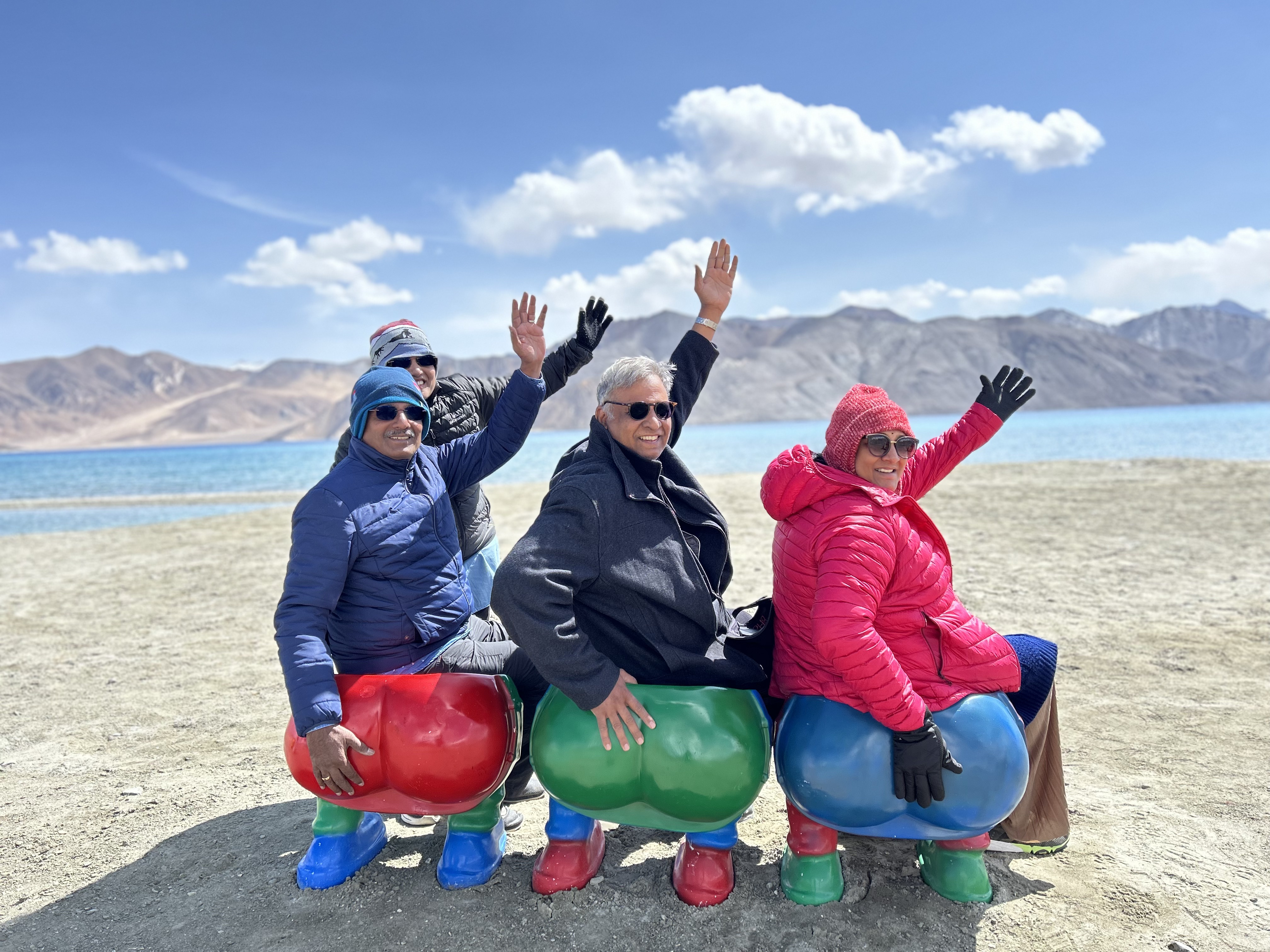
I wanted to introduce you to Pangong, a mesmerizing lake located in the Himalayas. Pangong Lake is situated at an elevation of about 4,350 m and extends from India to China. Its crystal-clear blue waters against the backdrop of barren mountains make it a breathtaking sight.
Pangong Lake gained popularity after being featured in the movie ‘3 Idiots’. It is a popular tourist destination known for its scenic beauty and tranquility.
I highly recommend adding Pangong to your travel bucket list for an unforgettable experience. Pardon me for a shaky video, below, since my hands were dancing in the cold.
Upon our arrival in Pangong, we made a beeline for our accommodations at the charming “Misty Hills Cabins” Hotel. Nestled in a picturesque location, this gem of a hotel quickly stole our hearts and became the highlight of our ten-day journey. The staff and management were not only incredibly polite, but also went above and beyond to ensure our stay was nothing short of perfection. Misty Hills truly set the bar high for hospitality during our travels.
I must admit, the nights were frigid beyond belief. Bundled up in layers upon layers of protective gear, we braved the icy trek to the restaurant for dinner, which was only a stone’s throw away. The oxygen levels were alarmingly low, a fact that was palpable as we settled in for the night. Some of us experienced mild headaches or nausea, easily remedied with a trusty tablet or two. Not to scare you off, but just a friendly heads up. Of course, you could always choose to turn a blind eye and carry on with business as usual. But just a word.
“All good things must come to an end, and in this case, all is indeed well. I must admit, I’ve been bitten by the ‘3 Idiots’ filmy bug, so my writing may have taken on a bit of their quirky charm. The climax of this movie was shot here.
You can simply sit back and bask in the beauty of the lake for as long as your heart desires. The locals have even set up some typical ‘3 Idiots’ film props, like scooters and hoardings, for you to enjoy – for a small fee, of course.
I recently stumbled upon a blog claiming that the lake was destroyed post the film ‘3 Idiots,’ but I beg to differ. Visiting this place was no walk in the park, and we didn’t encounter the usual crowds or chaos. If it weren’t for the film, many of us wouldn’t have had the chance to witness this marvel.
After bidding farewell to Pangong, we headed back to our hotel to pack up. Our journey from Pangong to Leh was a straight shot with no pit stops. We hopped on a flight from Leh to New Delhi, and then from New Delhi back to Chennai. And just like that, our adventure came to a close. Until next time, Pangong!”
Our tour was organized by Tripolla.com, based in Srinagar, and we were in the capable hands of Zahid and Zia. Overall, they did a fantastic job, although the hotel in Leh Ladakh was a bit disappointing.
However, the cars and drivers were top-notch. Zahid was always just a phone call away and quick to adapt our itinerary on the fly when the weather threw us a surprise.
Tripolla. Near HDFC Bank, Panthachowk, Srinagar, email : info@tripolla.com


Leave a Reply